What are the odds of drafted baseball players making the Major Leagues and staying for at least three year? Richard Karcher studied the numbers over the 16 year period from 1996-2011 and they provide a view into how difficult it is to make the highest level of play.
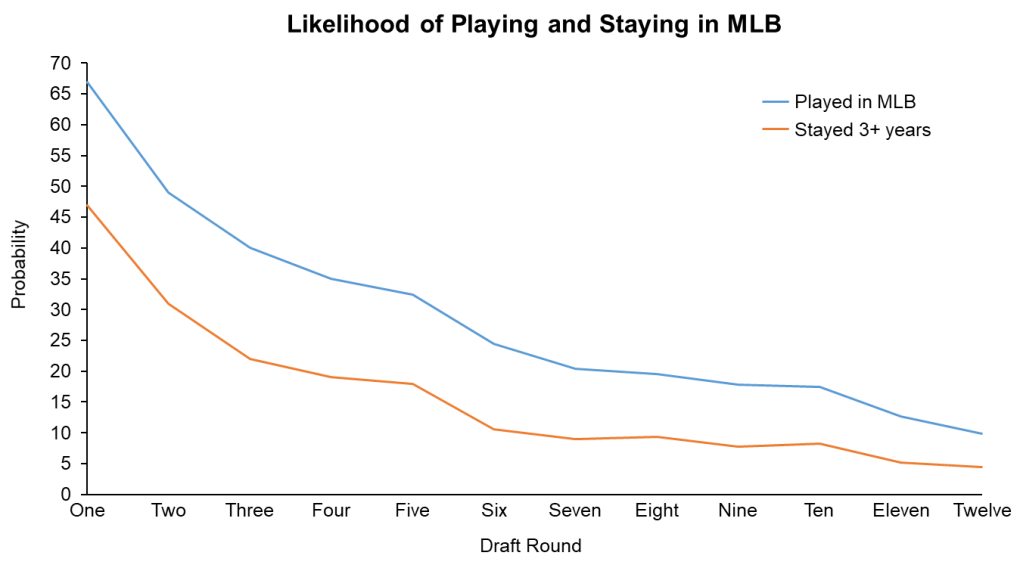
It’s no surprise that higher round sections make it much more frequently. First round players are twice as likely to play MLB as fifth round selections and fifth rounders are almost twice as likely as tenth. Early round players are more likely to play more games as well. Baseball America studied recent data as well and discovered that “81% of drafted first rounders get a hit and 23% get 1,000 hits. This drops to 63% and 8% respectively for the second round.” Every once in a while, a diamond is the rough becomes a late round star.
High School Draft Picks
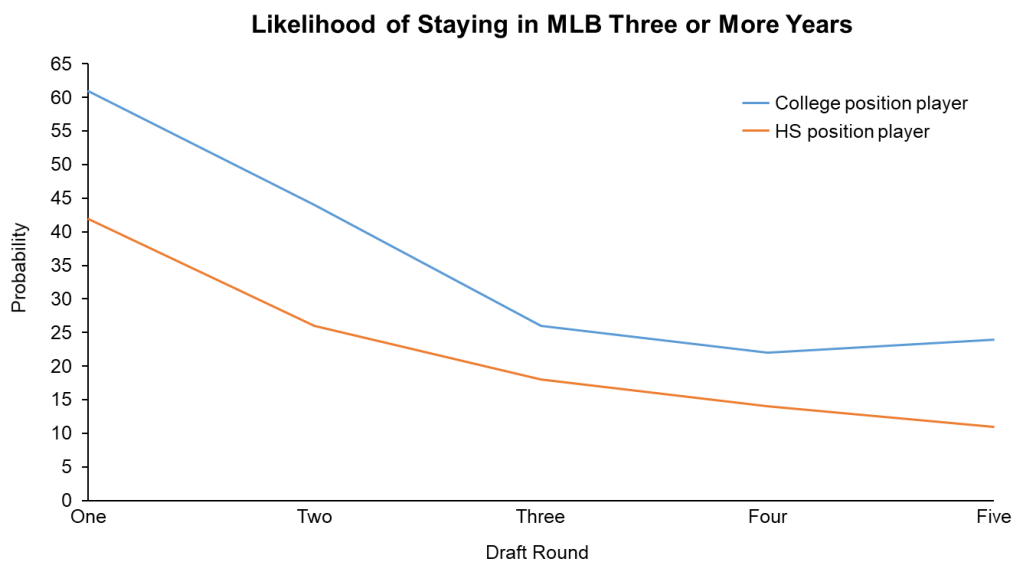
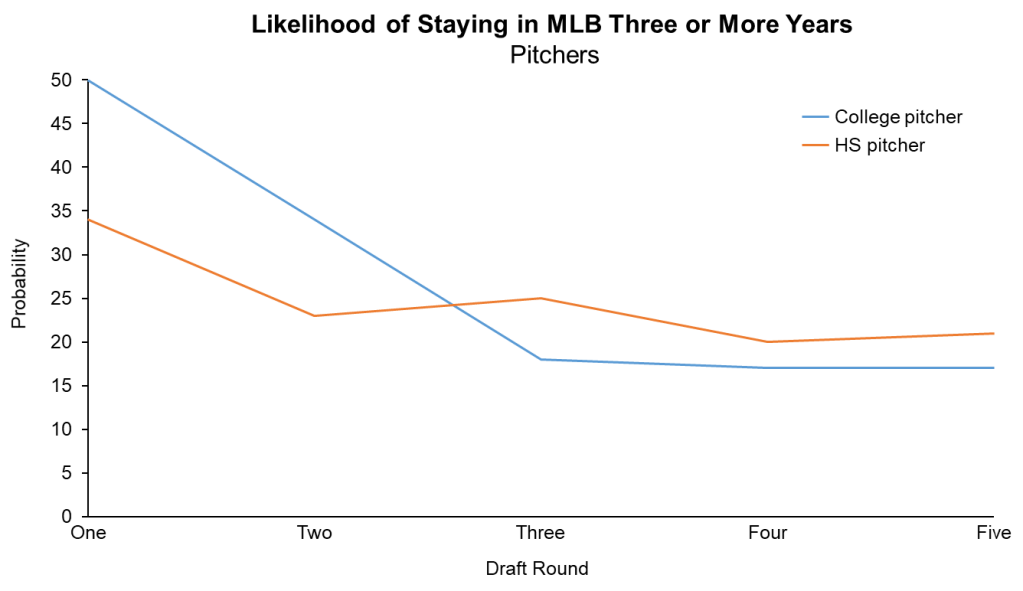
If we drill into the data from the first five rounds a little more, high school draft picks in the first two rounds are significantly less likely (~9 points) than average to make the majors and a similar level of short fall for sticking around three or more years. According to BA, the most likely first rounder position players to play at least one game is first base at 90% and least likely is a close race between second base and outfield at ~75%. They still are less likely than average in rounds three through five, but the difference ranges from 0%-4%. Digging in even more, surprisingly, high school position players are bigger misses in making it to MLB than pitchers across all five round. Pitchers from the first two rounds are then less likely to last in the majors at least three years. Round three to five pitchers last longer than position players once they’re called up (using the three year mark).
College Draft Picks
Obviously on the flip side, college draft picks are more likely than average to make the MLB roster and last three years. They’re safer selections because they’re more seasoned against high level competition. In this segment, position players from all five rounds significantly outperform pitchers for both making it and sticking around for some time. In the first round, college first basemen played an MLB game 90% of the time and on the other end of the spectrum second baseman played 77%. Both number are similar to the high school success rate. Second round success rate for playing at least one MLB game was higher for college players drafted in the second round across all positions.
Overall a college position player from the first five round has just over a coin flip chance of making the majors and just over 1/3 chance of staying three or more years. Even with these odds, they are the most likely of all across the five rounds to have longevity in professional ball. They significantly outperform high school position players, who haven’t necessarily proven that they can hit the highest levels of pitching.
Overall, college pitchers have just under a 50% chance of visiting the show and just under 30% chance of hanging around a few years. Interestingly, after the first two rounds, they don’t last as long as high school pitching picks implying that the well of pitching talent dries up quickly or they get injured and don’t return to the same level.
Bottom Line of Success from the Draft
What does all of this mean? In the end, it’s a big guessing game that that scouts aren’t very good at despite the metrics and technology used in the MLB draft combine and other places. The combine wasn’t a factor in the metrics above since 2021 was the first one, but metrics have always been a part of measuring talent. Just skim the 2016 draft list and you likely won’t know many names before pick #59. With the velocity pitchers are throwing to challenge hitter, level of injuries to pitchers and other factors, making it and staying is just so difficult and no one at the youth, high school or college level has a clear crystal ball to see who the future Hall of Famers will be.
 Monster Baseball
One thought on “From Draft Day to the Majors: How Often Do Baseball Prospects Make It Big?”