
Exit velocity has become a more and more important metric with the proliferation of technology such as Rapsodo, HitTrax, TrackMan and Yakkertech. Using these tools, the two most common metrics are average exit velocity and 90% exit velocity. When those options aren’t available to track in game or in cage metrics, maximum exit velocity can be captured with a radar gun like Pocket Radar.
Analyzing the Exit Velocity Data
Many showcases use this approach as a way to quantify player power on their profiles. As with baseball 60 yard times and 10 yard times, the question is what’s a good number for a player’s age. The data below is from a national showcase, so it’s based on a group of players who are considered the best in the country rather than being representative of the full baseball player population. The data is also from static balls hit off a tee with a wood bat. Balls in games would surpass these numbers due to the energy created by the pitch striking the bat.
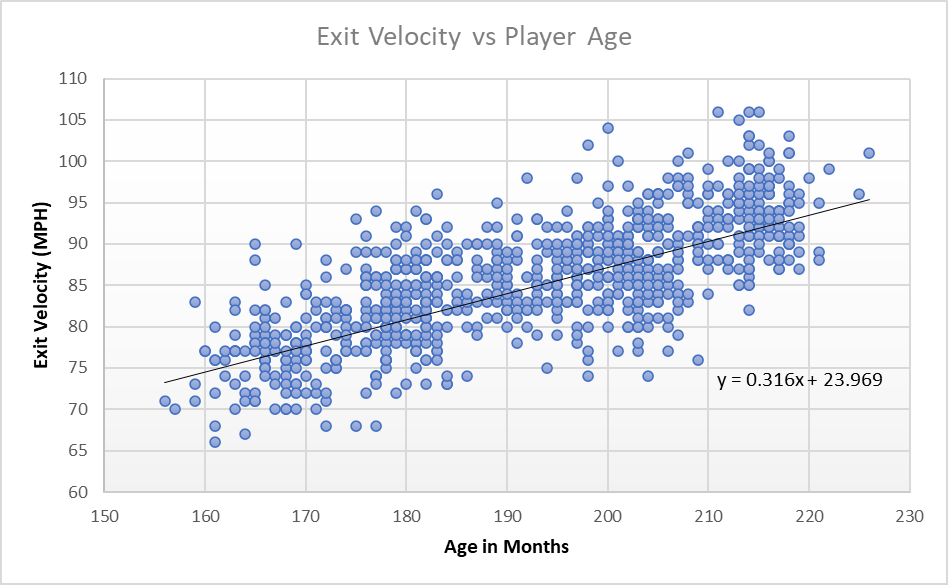
Exit Velocity Improvements with Age
As you know, 180 months is a 15-year-old, so generally a player who’s in his freshman season. The average for elite players at this age is 80 mph. Velocity seems to increase ~4 mph per year, so a 17.5-year-old (210 month) senior would average 90 as their maximum off a tee. The most elite power hitters produce velocities of 10 mph above their same age peers with the top high school players crossing 100 mph. 100 mph is first crossed at age 16.5.
According to Baseball America, “players on average add 4 mph to their average exit velocity between ages of 18 and 22…metrics begin to stabilize after 22 years of age, with little to no gains after.” You can see the top 2022-2024 rookie players average and 90% velocities at Baseball America with a subscription. They range from an average high of 94.3 mph for Matt Wallner to an average low of 86.6 mph for Steven Kwan. Keep in mind these are game numbers with wood bats. The 90% velocities topped out at 109.0 mph for Tristan Casas to a low of 98.8 mph for Kwan. Another BA article about 90% EV by age shows an average 90% level at 17 of 96.5 mph climbing to an average of 102.1 at 23.
In summary, top players gain ~4 mph from ages 14 to 18 and then 1 mph per year from 18 to 22 or 20 mph total during those years. If you want to train bat speed to increase exit velocity, invest in Driveline’s under and overweight bats or the Driveline youth version. Driveline and Applied Vision also share their own versions of hitter aging curves including exit velocity and bat speed.
 Monster Baseball
5 thoughts on “Power in High School Baseball: Exit Velocity by Age”