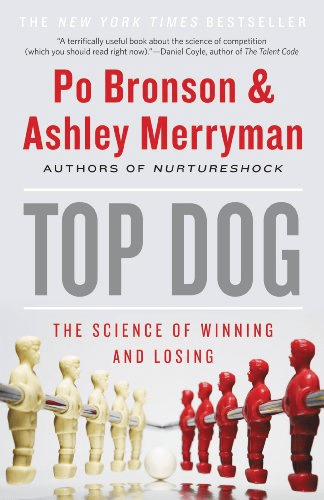
The book Top Dog by Po Bronson might be the best kept secret. It’s about why and how we compete in business, sports and life and why some people win and others lose. This is a summary of the key themes with some additional commentary and examples added by me. I highly recommend the book for a coach, athlete or business executive to better understand how to get the most out of your teams.
Competition makes us better
Competition motivates and drives creativity and innovation. It pushes people to take risks and find new ways to win. Creativity is driven by the freedom to experiment and make independent choices that may be unique. This agency leads to flexibility and adaptably in problem solving. The movie Adidas vs Puma captures how competition between brothers drives innovate in the shoe business. Competition driving innovation is also illustrated in music history as Luther wanted congregations to participate in worship services and therefore wrote songs for the congregation to sing in contrast to the Gregorian chants that were limited to the Catholic choirs where the congregation listened passively. Not to be outdone in competition, Catholic church countered by allowing musical instruments in worship, which many Protestant churches during the Reformation didn’t allow, and attracted people back to its services.
To make us better, competition needs to be designed well
Competition facilitates improvement, but the design of the competition is critical. People need to believe that they’ll have a fighting chance against others of similar skill sets, so that they think winning is possible. Competition also needs to be personal (i.e., against a small enough group to affect our worth). Ideally, it’s against a named small list of people or companies to be the most motivational. People who don’t think they have a realistic opportunity to win tend to drop out early or not enter at all. For example, sales teams that fall behind in a competition early or don’t feel like their territory gives them a chance to win, don’t put in as much effort and the incentive backfires. This can be why bio-banding in sports tends to be better than purely age or grade level competition. Players of like skill sets can push each other rather than feeling like they have no chance.
Be confident but not over-optimistic
There’s an interesting tension that arises from the book where competitors need to be confident enough to enter a competition (optimistic), but work hard for success to come to fruition (pessimistic). People who focus on the upside of what they’ll win compete more than those who focus on the odds of winning. They chase the opportunity rather than being preoccupied with the risk of falling short. As a result, they enter the race rather than staying on the sidelines.
Over-optimism leads to more risk-taking, which may not be a good thing especially if you’re running a space shuttle launch. Over-optimism is generally negative because it causes people to relax and not put in as much effort as they would otherwise. Pessimism drives more purposeful preparation and actions. This echos Andy Grove, the CEO of Intel’s, idea that “only the paranoid survive.” They’re always looking for ways to work faster or smarter to outrace the competition in business and life. Pessimists’ low expectations also makes them more resistant to failure than the frequent disappointment optimists may face.
Pressure is good to a point
People need pressure to perform their best. The right amount of stress actually enhances performance. Finding the right amount to stimulate a person, but not over-stimulate is the key. This is called the Individual Zone of Optimal Functioning (IZOF) and was named by Yuri Hanin. For people who understand this, reframing nervousness as a positive state of excitement that improves performance can enable people (like GRE test takers) to make fewer mistakes. Professional athletes interpret anxiety as beneficial while amateurs view it as detrimental. Professionals are confident that they’re in control and prepared and that goals are attainable. They’re stressed by not threatened. The goal isn’t to relax, but to reach the IZOF.
Playing to win and playing not to lose are different. The former is a challenge and the latter is a threat, which pushes pressure beyond the IZOF. Trying not to make a mistake often leads to mistakes. Mistakes can become contagious and cascade to teammates in a mirroring process.
Home field advantage is real in sports and life. It’s not always clear why, but it could be because of the level of comfort in a familiar and more friendly environment. Find ways to compete on your own turf such as inviting teams to compete against you at home or negotiating a key contract at your own office.
Proactively anticipate competitive challenges
Don’t take success for granted. It could really just be luck. We should learn from successes through post-mortem reviews as well as failures to balance over-optimism. We should also be proactive with anticipating challenges. This is also the idea of pre-mortems in business, which help flesh out issues with projects to preempt them before they occur.
Counterfactuals are conditional thoughts in which the opening clause premises something counter to fact like “If I had only…” or “If I hadn’t made that mistake.” Additive counterfactuals constructively prepare new options to overcome obstacles to be prepared if the situation happens again. They enable a problem-solving mindset and new creativity resulting in better performance overtime. In contrast, subtractive counterfactuals focus on regret from the mistake.
Additive counterfactuals can be used proactively. For example, a baseball player could write a brief narrative about the obstacles he might face trying to make an elite team or varsity at a young age. This type of planning sensitizes him to the level of challenge he may face to help decide if the effort is worth the result. The challenge then becomes tangible milestones towards achieving the goal.
Challenge increases motivation biochemically
Competing changes body chemistry with greater intensity leading to more change. Testosterone spikes with a challenge, driving motivation and decreasing fear lowering the inhibition to take risks. Likewise motivation increases testosterone. In contrast, if someone is overconfident, the body many not rise to the challenge with a testosterone increase. In addition, when competing against someone you care about, or making friends during a sporting event, testosterone drops.
Respect is important to high testosterone people. They’re motivated by what gains respect in a culture, so being clear about the rules or desired behaviors is important. For example, players with higher levels of the chemical had better teamwork because they wanted to be more respected by other players. They also become more intensely rationale and enforce rules and can get angry when others don’t stay in compliance.
Team performance is driven by culture
Team culture is critical to team success. This begins with how member relate to each other. In business, teams that focus on titles and hierarchy underperform those that prioritize knowledge sharing and expertise regardless of level. They work best when everyone has clear defined roles. Successful business teams are also smaller and therefore have fewer relationships to manage. Everyone feels responsible and knows what the others are doing. Small teams require fewer formal meetings to share information and are not dominated by a couple of people. Great teams trust each other to do their best. Struggling teams worry about free riding or stealing credit.
Team performance drives the quality of relationships, but teams can’t put the relationships ahead of the mission to avoid offending someone by challenging them with a new or different idea. Mirror processing is a way that teams unconsciously influence each other with non-verbal cues. Moods are contagious and you can catch them from teammates.
Manage stars differently
Star players often don’t like to be in teams because they feel like their work will be diminished and have less of a challenge. They face an elevated level of scrutiny and need to be managed differently. Duke coach Mike Krzyzewski says, “I need to be the best player’s best friend. Being the best player is a lonely position. Even though you get accolades, no matter how good of a team you have, there will always be a level of jealousy….you have to motivate the star…if they push ahead, everybody else has to work to catch up.”
Men and women compete differently
Men and women compete differently. Men take more chances with long odds and make larger bets. Women play to not lose and are willing to finish what they start. Men don’t handle significant losses well and their effort tends to wain if they can’t keep up. They take more changes when rewards are non-linear and create a wider spread of outcomes. Women are more conservative and only enter into games they expect to have a reasonable chance to win.
Boys like group activities that provide a unified sense of purpose while girls prefer pairs where they can take turns. Groups can manage competing ideas and diffuse confrontation to focus on a greater purpose. Pairs can’t because the relationship depends on equality and things in common. Pairs are fragile and less likely to succeed long-term. The natural style of pairs is self-depreciating. Competition (or jealously) can destroy the relationship. Boys don’t struggle to pick a leader of a group. Girls do. They also focus on relationships more than the task of a group. Younger siblings are more aggressive, risk-taking and persistent. They gravitate to more dangerous sports. They’re less intimidated by competition.
Other differences
Novices improve with positive feedback. Experts improve with constructive criticism. Introverts do best when working alone and increase performance in a competition. Extraverts are better in groups, need oversight for motivation and perform more poorly in competitions.
Implications and recommendations
Competition makes us better if managed correctly. Coaches can gamify and measure practices like Wake Forest baseball (e.g., score who landed the most bunts out of ten chances), but design competitions in a way that give weaker players a chance to improve against other weaker ones while stronger players push each other to the next level. Culture needs to be managed carefully. Coaches need to motivate players by focusing the rewards of winning while also ensuring that players aren’t overconfident and lazy when facing less challenging opponents. They also need to root out players with behaviors that can cause the team to spiral down.
If you like sports books like Top Dog, look at my list of baseball analytics books like Moneyball.
 Monster Baseball
2 thoughts on “Top Dog: The Science of Winning and Losing”