
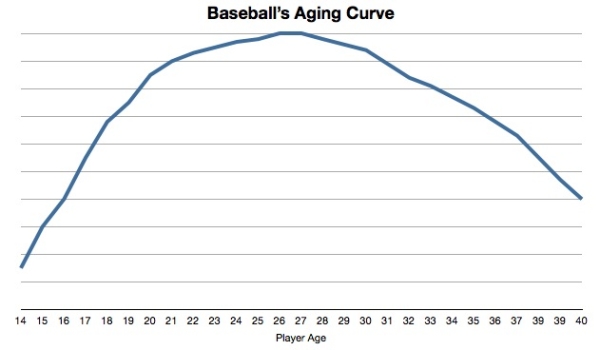
As baseball players progress through their careers, the relentless march of time becomes an undeniable adversary, affecting their ability to throw and hit with the same vigor as they age. The journey of these abilities is best exemplified through aging curves.
The Significance of Draft Age – Youth is a Precious Asset
Quoting a Baseball Prospectus article by Rany Jazayerli, “Young high school hitters are simply much more likely to develop into stars, particularly players who weren’t elite picks.” How young is young? In his 2011 BP study, he used the following definitions, “Very Young” players were less than 17 years 10 month on draft day while “Very Old” players were more than 18 years 7 months. He concluded that very young players produced ~25% more value for their draft slots than average and very old ~33% less value. Very few if any players in recent drafts are considered very young. Most fall in the very old category due to reclassing.
In practical terms, Jazayerli explains, “A 17-year-old player drafted #100 overall has as much expected value as an 18-year-old drafted #24. If a player who might look like a third-round pick on talent alone happens to be a full year younger than his draft class, he ought to be considered a late-first-round pick. That is a massive, massive impact. One year of age is the difference in the expected value of pick #25 and pick #11. It’s bigger than the difference between pick #5 and pick #8.”
Avoid the Age of 19 on Draft Day
Given the emphasis on youth at the draft, being 19 in high school on draft day poses a substantial challenge for early picks. A cursory look at recent draft boards underscores the rarity of 19-year-old high school players going in the first or second round, with exceptions like Colton Montgomery in 2021.
Age 27-29 are Peak Production Years for Hitters
Turning from the beginning of a pro baseball career to the heart of it, MLB has an aging curve where peak physical skills and ability intersect between age 27 and age 29. The rapid decline for pitchers and hitters begins at age 30. Fangraphs breaks aging down in more detail. The decline for both pitchers and hitters accelerates at age 30. Fangraphs offers detailed insights; for hitters, wRC+ peaks at 26, ISO holds on until 30, BABIP declines from 20 onwards, walk rate peaks between 28-32, and strikeout rate is lowest at 25. Medium also examines the performance of hitters over time including hard hit rate, barrel rate, max exit velocity and average exit velocity. Both power metrics peak at 27 and decline quickly while contact metrics hit their apex at 27 and slowly erode to 32 before the numbers fall off the table.
Aging curves have remained fairly stable over time as shown by the Hardball Times and studied in more detail for players with over 5,000 PAs, which shows a flatter curve.
Age 27-29 are Peak Years for Pitchers Too
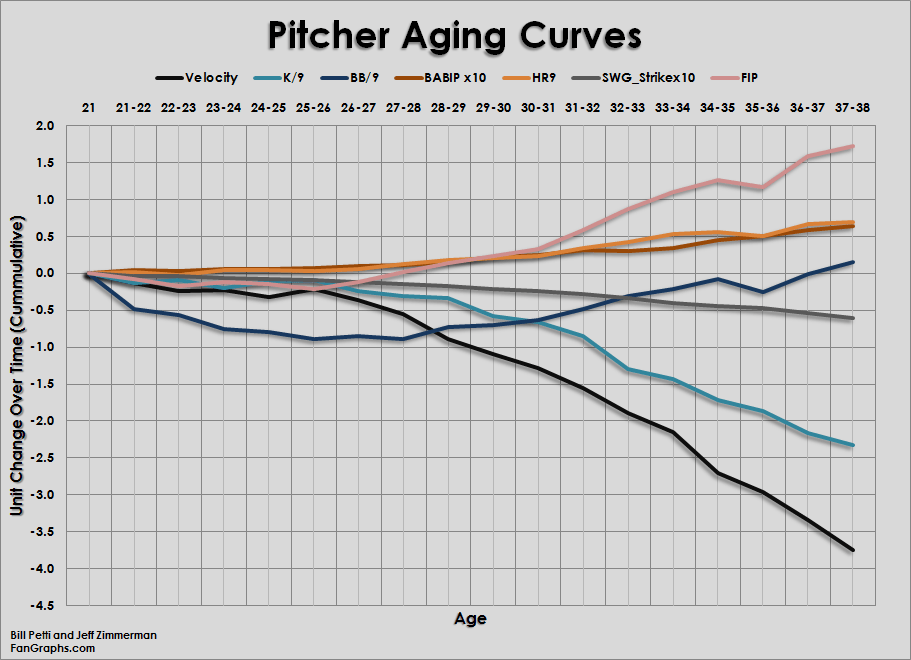
Pitchers also experience their prime between ages 27 and 29, with varying metrics reaching optimal levels during this period. Walk rate is lowest at 25-27, BABIP is best between 20-22, home run rate hits its lowest point from 20-26, and strikeout rates peak between 22-28. Fastball velocity reaches its apex at ages 20-21 before experiencing a gradual decline. A different Fangraphs article about pitchers shows less pronounced declines than I described and are captured in the chart below. The article also breaks out starting pitchers from relief pitchers.
Careers are Fleetingly Short
According to The Score, the median career spans 2.5 years for pitchers and 3.0 for position players, with the average service time at 3.7 years by the end of 2023—a year shorter than two decades ago. Playing into arbitration years or lasting over six years to reach free agency is a formidable challenge. Consequently, players aged 30 or over contribute to only 30% of plate appearances over the last decade. Star players, however, can defy the norm, displaying unique patterns to extend their careers past 30.
Understanding the ephemeral nature of baseball careers is essential for players navigating this competitive terrain.
If you want to understand the implications of age for younger players, read my post on the relative age effect in youth baseball, exit velocity for high school players and high school baseball 60 times. Also read about how height affects hitting performance.
 Monster Baseball
2 thoughts on “Aging Curves in Pro Baseball”