The Major League Baseball (MLB) draft operates differently than drafts in other professional leagues. Unlike the NFL or NBA, MLB does not use a rigid slotting system with preset signing bonuses. Instead, each selection in the MLB draft has an assigned “slot value” that serves as a guideline for teams. On the player side, each athlete must determine the signing bonus he believes he is worth. Draft day then becomes a matching process between teams and agents.
Flexibility in Spending
Because the system is flexible, teams can strategically spend below or above the assigned slot values. For instance, suppose a pick with a $3 million slot value goes to a player seeking $2 million. The remaining $1 million can then be used to entice another player who requires a larger bonus than the assigned slot value. If a player and team cannot agree on a number, the player may choose to attend college (if coming out of high school) or return to college (if already there and draft-eligible).
Average Values for First-Round Picks
Over the last five drafts, first-round picks have carried slot values ranging from around $2.5 million to over $8 million. However, the actual amount each player receives can differ significantly based on team preferences, the player’s perceived value, and negotiating power.
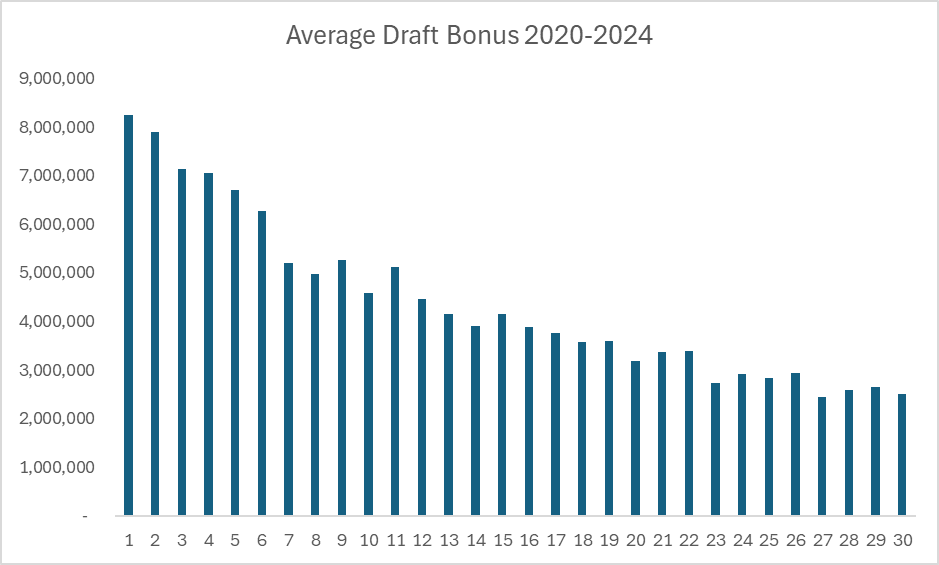
In the top ten picks, slot values can fluctuate by more than $1 million from year to year. This volatility reflects changing team priorities and varying assessments of player potential.

Underslot Deals
A notable example of an underslot deal occurred in the 2021 draft. The Pittsburgh Pirates selected Henry Davis as the first overall pick (often referred to as “1–1”) but signed him for $6.5 million, the lowest bonus for a top overall pick in the 2020s. As a result, several subsequent picks—including the second, third, fourth, and sixth—each received larger signing bonuses than Davis.
Similarly, in 2020, Heston Kjerstad was drafted second overall by the Baltimore Orioles and signed for $5.2 million, which was below the typical value for the second pick. Despite this underslot deal, Kjerstad still maximized his situation by going higher in the draft than many projected, securing prestige and a solid bonus.
Why Players Accept Underslot Deals
Players and their agents often weigh their options against the entire top-ten landscape. If an agent determines that no other team in the first ten picks would offer more than, say, $6.5 million for a given player, it can make sense for that player to accept an underslot deal in the highest possible draft position. Draft position can boost a player’s reputation and future marketability, even if it comes with a slightly smaller signing bonus
MLB’s Power and Discounted Values
Regardless of the numbers, MLB teams are getting players at a significant discount to their open market value because of baseball’s monopoly status with the government leveraged to their collective bargaining agreement (CBA). In 2019, Fan Graphs created an estimate of the value of MLB’s first round slots and gave the first overall pick a $45 million value and the 30th pick a $10 million value. $10 million is more than any player received in the past five years, so in reality players are capturing 20%-25% of their free market value and teams are receiving the rest.
Being the number one overall selection isn’t a guaranteed path to MLB. Learn about the biggest draft busts in baseball history.
 Monster Baseball
2 thoughts on “Major League Baseball First Round Draft Bonuses”